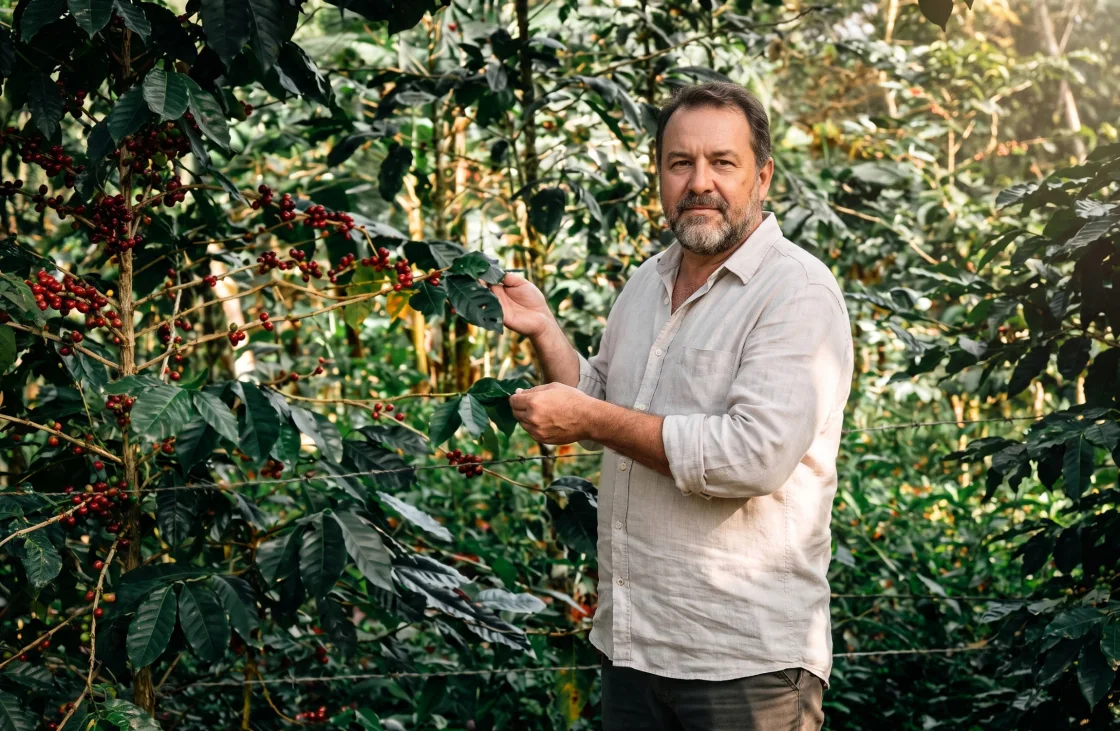
La Hermosa, Akatenango.
Farm owner: Max Perez
Dimensions: 196 ha
Farm treatment: wash, honey and natural.
Variety: Tritica, Red Bourbon, Yellow Bourbon, Katurra, Katuai, Pace, Pacamara and Gesha.
Crop collection: December-April
FERMA:
The La Hermosa (Rrebavica) is located in Akatenango, Department of Chimaltenango, in a valley 80 km from the capital, Guatemala City, surrounded by mountains and volcanoes, where the climate diversity of the area and soil characteristics have a positive effect on taste, and coffee grown in the area is visible in the form of capping.
Max Peres was born and raised among coffee plantations and wanted to start his own coffee business as a child. In 2010, this opportunity was introduced. The realization of the dream was made possible by the tremendous efforts of his family and by a clear understanding of the goal of building a coffee-pest farm that would combine tradition and innovation to provide its customers with excellent coffee on the one hand and have a positive influence on the community on the other.
After the acquisition of land in 2010, the project began to take shape, a team was formed and family experience, together with an innovative vision, had a significant impact on which varieties and varieties to plant, which shade trees to use and other technical features. At each stage from seed selection to planting, each part was carefully monitored to guarantee the success of the project.
A coffee plantation is a long-term investment, so it's important to focus on every detail.
The farm is divided into 13 full-scale plots, so all coffee is carefully collected and processed in accordance with best practices in soap, natural and honey-processing.
Over the years, the quality of coffee collected on this farm has been noted by national and international prizes, including the Cup of Excellence auction programme.
PROCESS: FLAMMABLE
Most of the coffee produced in Guatemala is processed by this method, and La Hermosa is no exception. Coffee is collected manually at 21Bch.
The remains of the pergamine are removed during fermentation, not mechanical. The processing period is designed to allow the reuse of water that promotes coffee berries during processing, allowing the effective use of the one that is needed for depulpation and berries washing.
The drying process occurs in the sun, pre-saturation is performed on a cemented patio site and stage two on raised beds, average time of drying is 10-15 days.
Our favorite type for this sort of processing is Pacamara.